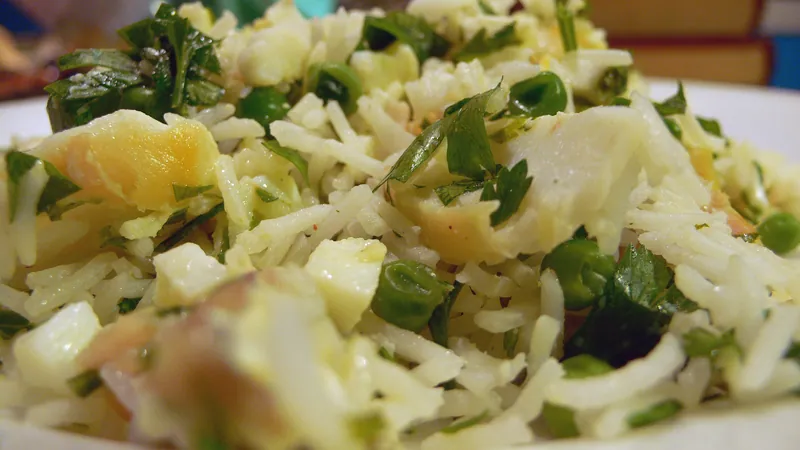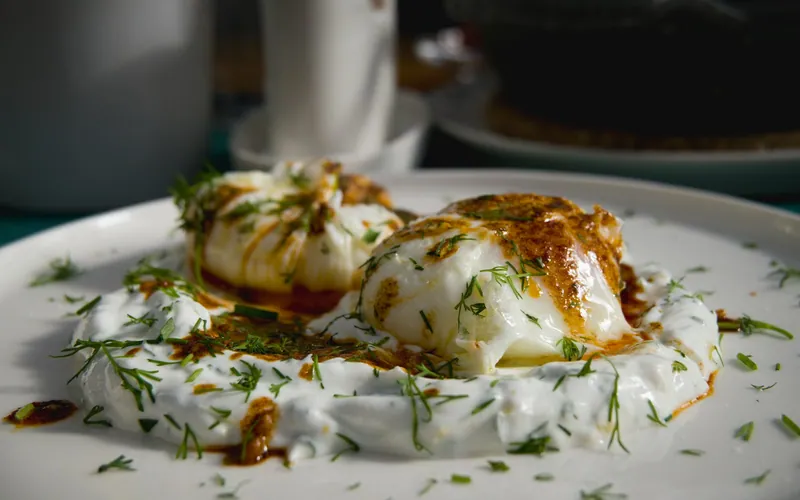
Close view of smoked haddock kedgeree with long-grain rice, large pale fish flakes, chopped cooked egg, green peas and parsley

Photo: Justinc / Wikimedia Commons · CC BY-SA 2.0

Breakfast Recipes

Smoked Haddock Kedgeree with Eggs & Peas

Fluffy basmati rice, gently poached smoked haddock, firm-boiled eggs and sweet peas meet in a warm curry-spiced skillet for a practical Anglo-Indian brunch or supper.

Prep20 min
Cook40 min
Total60 min
Cost$4.60

Directions

  1. Rinse and drain the basmati rice

    Put the rice in a bowl, cover with cold water and swish with your fingers. Drain and repeat 3 or 4 times, until the water is only lightly cloudy, then leave the rice in a fine-mesh strainer for 10 minutes. Rinsing removes loose surface starch so the finished grains stay separate rather than forming a paste when they are folded with fish.

  2. Gently poach the smoked haddock

    Lay the haddock in a wide 12-inch skillet, cutting the fillets once if needed so they lie flat. Add the milk, 1 cup water and 1 bay leaf; the liquid should come most of the way up the fish. Bring just to a bare simmer over medium heat, then lower the heat, cover and poach for 6 to 8 minutes, until the thickest part is opaque, flakes easily and reaches 145°F (63°C). Transfer the fish to a clean plate. Strain the poaching liquid into a measuring jug and reserve 1 cup; discard the bay leaf. When the fish is cool enough to handle, remove the skin and any bones and break it into large 1- to 2-inch flakes.

  3. Boil and quarter the eggs

    While the fish poaches, put the eggs in a small saucepan and cover with cool water by 1 inch. Bring to a full boil, cover, remove from the heat and let stand for 10 minutes. Transfer to ice water for 5 minutes, then peel and cut each egg into quarters. The yolks should be fully set so they remain distinct when arranged over the hot rice.

  4. Cook the separate, fragrant rice

    Melt 1 tablespoon butter in a 3-quart saucepan over medium heat. Add the drained rice and stir for 1 minute. Pour in the reserved 1 cup poaching liquid and 1 1/4 cups water, then add the remaining bay leaf. Bring to a boil, stir once, cover and reduce the heat to low. Cook for 12 minutes without lifting the lid. Remove from the heat and rest, still covered, for 10 minutes. Discard the bay leaf and fluff gently with a fork.

  5. Bloom the curry-spice base

    Wipe the fish skillet clean and melt the remaining 2 tablespoons butter over medium heat. Add the onion and cook for 8 to 10 minutes, stirring often, until soft and golden at the edges. Add the garlic and ginger and cook for 1 minute. Stir in the curry powder, coriander, cumin, turmeric and cayenne for 30 seconds, just until fragrant. If the spices begin sticking, add 1 tablespoon water rather than extra fat.

  6. Fold the kedgeree without crushing the fish

    Add the peas and cook for 2 minutes. Fold in the hot rice, 1/2 teaspoon salt and the black pepper until the grains are evenly yellow and steaming. Add the haddock, parsley, cilantro if using and lemon zest; fold only 3 or 4 times with a broad spatula so the fish stays in the large flakes visible in the finished dish. Taste before adding salt because smoked haddock and its poaching liquid vary considerably in salinity.

  7. Arrange the eggs and serve hot

    Remove the skillet from the heat and place the egg quarters over the rice. Cover for 2 minutes so the eggs warm through without overcooking, then scatter with extra parsley. Serve immediately with one lemon wedge per person. The finished kedgeree should be moist but not creamy, with separate rice grains, obvious pieces of pale smoked fish, green peas, herbs and cooked egg matching the verified photograph.

Why this works

Why it worksPoaching the smoked haddock below a boil keeps its flakes tender, while a measured portion of the strained milk-water liquor carries the fish's savory flavor into the rice without making it heavy.
Why it worksRinsing, briefly toasting and resting the basmati before fluffing all limit surface starch and protect the separate long grains that distinguish kedgeree from a creamy rice dish.
Why it worksCooking the onion until golden before blooming the ground spices builds sweetness and releases fat-soluble aromas without leaving raw curry powder in the finished skillet.
Why it worksAdding the fish only after the rice and peas are hot prevents repeated stirring from shredding it; a broad spatula preserves the substantial flakes shown in the licensed photograph.
Why it worksFully set eggs, sweet peas, lemon zest and fresh herbs balance the smoky fish and warm spices with distinct textures, color and acidity.

Useful kitchen gear

Tools that make this easier.

Compare the function and specifications first; skip anything your kitchen already handles well.

Paid links: As an Amazon Associate I earn from qualifying purchases. You pay no additional cost.

Swaps & notes

Easy swaps

  • Hot-smoked salmon can replace smoked haddock ounce for ounce. Skip the milk poach, flake the ready-to-eat salmon and use 1 cup low-sodium fish or vegetable stock plus 1 1/4 cups water for the rice.
  • For a less smoky version, use 1 1/4 pounds fresh cod. Poach it as directed, season the poaching liquid with an additional 1/4 teaspoon salt and still verify a 145°F (63°C) center.
  • Frozen peas can be replaced with 1 cup thawed shelled edamame for more bite, though that makes the dish a modern variation and introduces soy as an allergen.
  • Brown basmati is not a direct timing swap. Use the package's liquid ratio and cook time, then begin the onion-spice base during its final 15 minutes so every component finishes hot.
  • Use olive oil in place of butter and unsweetened oat milk in place of whole milk for a dairy-free variation. Check the smoked fish label because some prepared products may contain additional allergens.

Cook notes

  • Historic UK describes British kedgeree as a version of Indian khichri, and its breakfast history identifies the later British form as lightly spiced rice with smoked fish and boiled eggs. This recipe uses the term Anglo-Indian for that adapted dish and does not present smoked haddock as an ingredient of the many Indian khichri traditions.
  • The UK Food Standards Agency warns that cooked rice should be cooled quickly, ideally within one hour, refrigerated for no more than 24 hours and reheated only once until steaming hot. The storage directions deliberately follow that rice-specific guidance rather than the longer window often used for other leftovers.
  • The CC BY-SA 2.0 photograph by Justinc was inspected at full size before publication. It clearly shows long-grain rice, large pale fish pieces, cooked egg, green peas and chopped herbs; the title, final assembly, ingredient list and alt text are restricted to those verified visible details.
  • Choose undyed smoked haddock when available so the recipe's turmeric, not artificial coloring, controls the rice's yellow tone. Dyed smoked haddock still works but may make the fish brighter than the verified photograph.
  • A wide skillet poaches the fillets in a shallow layer and later gives six portions of cooked rice enough room to fold without crushing. The separate covered saucepan makes the rice timing predictable.
  • The 60-minute total includes the rice's 10-minute covered rest and the eggs' five-minute ice bath; these overlap with onion preparation and fish cooling.
  • This recipe contains fish, milk and eggs. Curry powder blends vary and may contain undeclared-by-name spices, so check every packaged ingredient when accommodating an allergy.
  • Calories and cost are estimates for one of six portions. The haddock's salt and fat content, the butter retained in the pan and local smoked-fish prices will change both.

Storage

Because cooked rice needs prompt handling, spread leftover kedgeree in a shallow container and refrigerate within 1 hour. Keep for no more than 24 hours, then reheat only once. Warm individual portions in a covered skillet over medium-low with 1 tablespoon water, stirring carefully, until steaming hot throughout and at least 165°F (74°C), then eat immediately. Freeze rapidly cooled portions without the egg garnish for up to 1 month; thaw overnight in the refrigerator and reheat once to 165°F. Refrigerate the eggs separately and use within 2 days. Do not leave the finished skillet at room temperature for more than 2 hours.

Questions

Why is my kedgeree wet or clumpy instead of fluffy?

The rice may not have been rinsed and drained thoroughly, the poaching liquid may have exceeded the measured 1 cup, or the covered rice may have been stirred before its 10-minute rest. Measure the strained liquid after poaching, keep the lid closed during cooking and resting, then fluff before the rice reaches the skillet. Fold with a broad spatula rather than stirring in circles.

Can I make smoked haddock kedgeree ahead for brunch?

It is safest and best-textured when assembled just before serving. You can poach and flake the haddock and boil the eggs one day ahead, chill both promptly in separate covered containers, then cook fresh rice and the onion-spice base. Add the cold fish with the rice and keep folding over medium heat until the entire skillet is steaming hot and the fish reaches 165°F before garnishing with eggs.

Is kedgeree the same dish as Indian khichri or khichdi?

No. They are historically related names and rice-dish traditions, but this British-style kedgeree is a distinct adaptation built around smoked fish, eggs and curry spices. Indian khichdi encompasses many regional preparations, commonly combining rice and lentils. Calling this recipe Anglo-Indian kedgeree keeps that relationship visible without treating the dishes as interchangeable.

Smoked Haddock Kedgeree with Eggs & Peas
Screen stays awake when supported.
1. Rinse and drain the basmati ricePut the rice in a bowl, cover with cold water and swish with your fingers. Drain and repeat 3 or 4 times, until the water is only lightly cloudy, then leave the rice in a fine-mesh strainer for 10 minutes. Rinsing removes loose surface starch so the finished grains stay separate rather than forming a paste when they are folded with fish.
2. Gently poach the smoked haddockLay the haddock in a wide 12-inch skillet, cutting the fillets once if needed so they lie flat. Add the milk, 1 cup water and 1 bay leaf; the liquid should come most of the way up the fish. Bring just to a bare simmer over medium heat, then lower the heat, cover and poach for 6 to 8 minutes, until the thickest part is opaque, flakes easily and reaches 145°F (63°C). Transfer the fish to a clean plate. Strain the poaching liquid into a measuring jug and reserve 1 cup; discard the bay leaf. When the fish is cool enough to handle, remove the skin and any bones and break it into large 1- to 2-inch flakes.
3. Boil and quarter the eggsWhile the fish poaches, put the eggs in a small saucepan and cover with cool water by 1 inch. Bring to a full boil, cover, remove from the heat and let stand for 10 minutes. Transfer to ice water for 5 minutes, then peel and cut each egg into quarters. The yolks should be fully set so they remain distinct when arranged over the hot rice.
4. Cook the separate, fragrant riceMelt 1 tablespoon butter in a 3-quart saucepan over medium heat. Add the drained rice and stir for 1 minute. Pour in the reserved 1 cup poaching liquid and 1 1/4 cups water, then add the remaining bay leaf. Bring to a boil, stir once, cover and reduce the heat to low. Cook for 12 minutes without lifting the lid. Remove from the heat and rest, still covered, for 10 minutes. Discard the bay leaf and fluff gently with a fork.
5. Bloom the curry-spice baseWipe the fish skillet clean and melt the remaining 2 tablespoons butter over medium heat. Add the onion and cook for 8 to 10 minutes, stirring often, until soft and golden at the edges. Add the garlic and ginger and cook for 1 minute. Stir in the curry powder, coriander, cumin, turmeric and cayenne for 30 seconds, just until fragrant. If the spices begin sticking, add 1 tablespoon water rather than extra fat.
6. Fold the kedgeree without crushing the fishAdd the peas and cook for 2 minutes. Fold in the hot rice, 1/2 teaspoon salt and the black pepper until the grains are evenly yellow and steaming. Add the haddock, parsley, cilantro if using and lemon zest; fold only 3 or 4 times with a broad spatula so the fish stays in the large flakes visible in the finished dish. Taste before adding salt because smoked haddock and its poaching liquid vary considerably in salinity.
7. Arrange the eggs and serve hotRemove the skillet from the heat and place the egg quarters over the rice. Cover for 2 minutes so the eggs warm through without overcooking, then scatter with extra parsley. Serve immediately with one lemon wedge per person. The finished kedgeree should be moist but not creamy, with separate rice grains, obvious pieces of pale smoked fish, green peas, herbs and cooked egg matching the verified photograph.