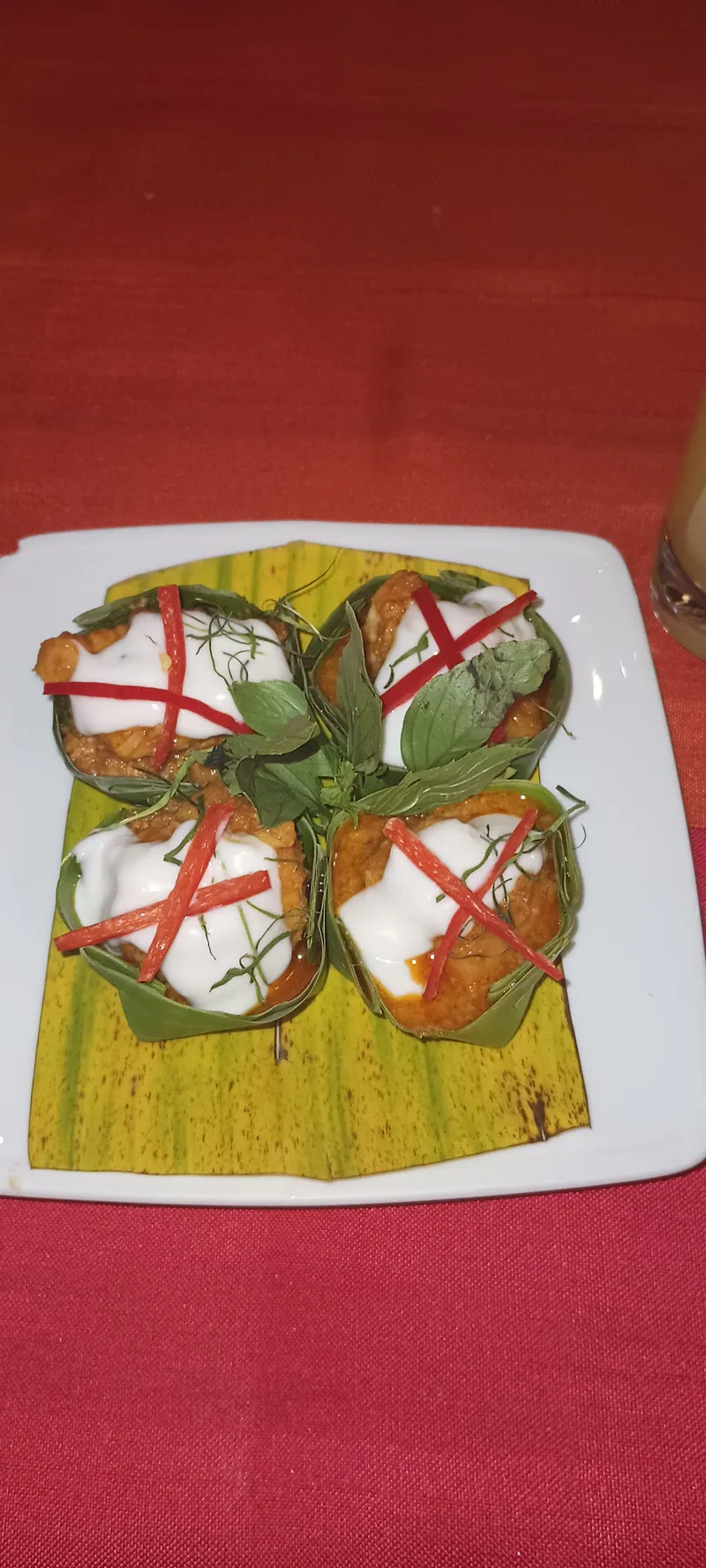
Three orange-gold Cambodian fish amok custards in square banana-leaf cups, topped with white coconut cream, red chile strips and green herbs

Photo: MoonsMoon / Wikimedia Commons · CC BY 4.0

One-Pot Dinners

Cambodian Fish Amok (Amok Trey) in Banana-Leaf Cups

Firm white fish steams in a silky lemongrass, turmeric and coconut custard, with practical folded-leaf cups and a ramekin fallback for home kitchens.

Prep45 min
Cook30 min
Total75 min
Cost5.25

Directions

  1. Soften and sanitize the banana leaves

    Rinse both sides of the banana-leaf squares and wipe them dry. Pass each square 4 to 6 inches above a medium gas flame for 5 to 8 seconds per side, or lay it in a dry skillet over medium heat for 10 to 15 seconds per side, just until glossy and flexible. Do not char it. Wipe again with a clean damp towel and keep covered so the leaves do not become brittle.

  2. Fold four leak-resistant cups

    Stack two softened squares with their grain running in opposite directions. Center a 4-inch ramekin on top, lift the leaves around it and make four overlapping pleats to form a 4-inch-wide cup about 2 inches deep. Secure each corner through the outer edge with a wooden toothpick, never through the cup base. Remove the ramekin and repeat to make four double-layer cups. Set them in a steamer basket or shallow heatproof pan where they stand level.

  3. Pound a fine kroeung-style paste

    Put the lemongrass, shallots, garlic, galangal, 2 sliced makrut lime leaves, bird's-eye chile, turmeric, shrimp paste if using and oil in a small food processor. Process for 60 to 90 seconds, stopping twice to scrape the bowl, until the mixture is a moist, finely textured paste with no hard lemongrass rings. Add 1 teaspoon water only if the blades cannot catch.

  4. Cook the aromatics without browning

    Scrape the paste into a small skillet and cook over medium-low heat for 4 to 5 minutes, stirring constantly, until intensely fragrant and slightly thickened but not browned. Cool for 5 minutes. This short cook softens the aromatics so the finished custard is smooth rather than fibrous.

  5. Separate the coconut cream topping

    Open the chilled coconut milk without shaking. Spoon 1/3 cup of the thick cream from the top into a small saucepan; whisk in the rice flour and 1/4 teaspoon salt. Measure 3/4 cup of the remaining coconut milk for the custard, stirring the can first if needed. Reserve any extra for another use.

  6. Coat the fish in the coconut custard

    Whisk the eggs, 3/4 cup coconut milk, cooked aromatic paste, fish sauce, palm sugar and remaining 3/4 teaspoon salt in a medium bowl until uniform. Fold in the dry fish pieces and stand for 10 minutes while the steamer heats. The mixture should coat the fish rather than look watery; if the fish released liquid, lift it into a clean bowl before adding the custard.

  7. Heat the steamer before filling

    Bring 1 1/2 inches of water to a steady simmer in a wide covered pot or wok fitted with a rack or steamer basket. The water must stay below the basket. Wrap the lid in a clean kitchen towel and tie the ends above the lid, away from the burner, so condensation cannot drip into the custards.

  8. Fill and steam gently

    Divide the fish and custard evenly among the four cups, keeping a 1/2-inch headspace. Set the cups in the hot steamer without letting them touch the water. Cover and steam over medium heat for 18 minutes; keep the water at a steady simmer, not a violent boil. Rotate the basket carefully, then steam 4 to 8 minutes longer, until the centers are softly set and a thin-probe thermometer inserted into the thickest fish-and-custard area reads at least 160°F.

  9. Thicken the coconut finish

    While the amok steams, set the saucepan of coconut cream over medium-low heat. Whisk for 2 to 3 minutes, until it just simmers and lightly coats the whisk. Remove from the heat; it should be spoonable, not stiff. If it thickens too much, whisk in 1 teaspoon water.

  10. Garnish to match the finished dish

    Rest the cooked cups in the open steamer for 3 minutes. Spoon a stripe of thickened white coconut cream over each orange-gold custard, then add red chile strips, very thinly sliced makrut lime leaf and two basil leaves or a small cilantro sprig. Remove or point out the securing toothpicks before serving with hot jasmine rice, if desired.

Why this works

Why it worksFinely processing and briefly cooking the lemongrass-heavy paste releases its aromatic oils while taming the tough fibers before they enter the delicate custard.
Why it worksPatting the fish dry and using full-fat coconut milk keeps the egg-to-liquid ratio controlled, so the amok sets softly instead of weeping.
Why it worksDouble-layered banana leaves with opposing grain directions resist small tears and hold the custard upright while contributing a subtle leafy aroma.
Why it worksA steady simmer and a towel-wrapped lid prevent aggressive bubbles and condensation from pitting or diluting the custard surface.
Why it worksThe 160°F center target accounts for the egg custard as well as the fish, whose separate FDA minimum is 145°F.
Why it worksRice flour gives the coconut topping enough body to remain visibly white on the hot orange-gold custard, matching the traditional-style presentation without turning gluey.

Swaps & notes

Easy swaps

  • Use haddock, catfish, halibut or tilapia in place of cod; choose thick, firm fillets and cut them uniformly. Avoid very oily fish or delicate sole, which can overwhelm or fall apart in the custard.
  • If banana leaves are unavailable, lightly oil four 6-ounce ramekins and set them on the steamer rack. The flavor will be less leafy, but the custard timing and safe-temperature test remain the same.
  • Fresh ginger can replace galangal, and lime zest can replace makrut lime leaf in the custard. Both are useful home-kitchen substitutions, but their flavors are not identical to the Cambodian aromatic profile.
  • For a shellfish-free version, omit the shrimp paste and add 1 additional teaspoon fish sauce. For a fully seafood-free version, this is not the right recipe; the fish is central to amok trey.
  • Ground turmeric works well in the paste. Fresh turmeric gives a brighter aroma but stains hands and equipment, so wear gloves and use a nonporous board.

Cook notes

  • Cultural and naming note: regional tourism guidance describes amok trey as a Khmer steamed fish curry cake or turmeric-coconut fish custard, commonly cooked in banana leaf. This home-kitchen version preserves the defining fish, kroeung-style aromatic paste, coconut-and-egg custard, banana-leaf vessel and steaming method while naming substitutions honestly.
  • Photo-match record: the licensed photograph is explicitly identified by its creator as three servings of amok trey. It visibly shows orange-gold steamed custard in square banana-leaf cups with white coconut cream, thin red chile strips and green herbs; every major visible element appears in the title, ingredients, method and alt text.
  • Banana-leaf cup sizing guide — 8-inch double squares around a 4-inch ramekin make a 4-inch cup for one quarter of this recipe; 7-inch squares make a narrower, taller cup that may need 3 to 5 extra steaming minutes; 9-inch squares are easier for beginners but require a wider steamer. Always keep a 1/2-inch headspace and secure only the outer walls.
  • Steamer conversion guide — bamboo basket over a wok: 22 to 26 minutes with the best condensation control; metal basket in a stockpot: 24 to 28 minutes with the lid wrapped; ramekins on a rack: 25 to 30 minutes because ceramic heats more slowly. Time is a guide only; all versions must reach 160°F in the center.
  • Custard diagnostic — watery before steaming: the fish was not dried or the coconut milk was too thin; bubbles and holes: the water boiled too hard; unset after 28 minutes: cups are crowded or the steamer lost heat; rubbery edge: the cups steamed too long. Adjust the simmer first and use temperature, not color, to call doneness.
  • Food-safety note: FDA guidance lists 145°F for fin fish and 160°F for egg dishes. Because amok is an egg-bound fish custard, this recipe uses the more protective 160°F center target; leftovers should be reheated to 165°F.

Storage

Remove garnishes, cool the cups promptly and refrigerate covered at 40°F or below within 2 hours. Eat within 2 days. Reheat in a covered steamer over gently simmering water for 8 to 10 minutes, or cover loosely and microwave at 50% power in 45-second intervals, until the center reaches 165°F. The egg-coconut custard can become grainy after freezing, so freezing is not recommended. Discard banana-leaf cups after serving.

Questions

Can I make fish amok without banana leaves?

Yes. Lightly oil four 6-ounce heatproof ramekins, fill them with the same 1/2-inch headspace and steam for about 25 to 30 minutes. Start checking at 24 minutes and require 160°F in the center. You will lose the leaf aroma and traditional-style presentation, but the fish custard will still set correctly.

Why did my amok turn watery instead of custardy?

The usual causes are wet fish, thin coconut beverage instead of canned full-fat coconut milk, or condensation dripping from the lid. Pat the fish very dry, measure only 3/4 cup coconut milk into the two eggs, wrap the lid and keep the water at a steady simmer. Let the cups rest 3 minutes so the custard finishes settling.

Is fish amok very spicy, and can I make it mild?

It should be aromatic and warm rather than aggressively hot. For a mild version, omit the bird's-eye chile from the paste and use the red garnish chile only on servings that want it. Do not remove the lemongrass, turmeric, galangal and makrut lime leaf; those aromatics, not chile heat, define the fragrant profile.

Cambodian Fish Amok (Amok Trey) in Banana-Leaf Cups
Screen stays awake when supported.
1. Soften and sanitize the banana leavesRinse both sides of the banana-leaf squares and wipe them dry. Pass each square 4 to 6 inches above a medium gas flame for 5 to 8 seconds per side, or lay it in a dry skillet over medium heat for 10 to 15 seconds per side, just until glossy and flexible. Do not char it. Wipe again with a clean damp towel and keep covered so the leaves do not become brittle.
2. Fold four leak-resistant cupsStack two softened squares with their grain running in opposite directions. Center a 4-inch ramekin on top, lift the leaves around it and make four overlapping pleats to form a 4-inch-wide cup about 2 inches deep. Secure each corner through the outer edge with a wooden toothpick, never through the cup base. Remove the ramekin and repeat to make four double-layer cups. Set them in a steamer basket or shallow heatproof pan where they stand level.
3. Pound a fine kroeung-style pastePut the lemongrass, shallots, garlic, galangal, 2 sliced makrut lime leaves, bird's-eye chile, turmeric, shrimp paste if using and oil in a small food processor. Process for 60 to 90 seconds, stopping twice to scrape the bowl, until the mixture is a moist, finely textured paste with no hard lemongrass rings. Add 1 teaspoon water only if the blades cannot catch.
4. Cook the aromatics without browningScrape the paste into a small skillet and cook over medium-low heat for 4 to 5 minutes, stirring constantly, until intensely fragrant and slightly thickened but not browned. Cool for 5 minutes. This short cook softens the aromatics so the finished custard is smooth rather than fibrous.
5. Separate the coconut cream toppingOpen the chilled coconut milk without shaking. Spoon 1/3 cup of the thick cream from the top into a small saucepan; whisk in the rice flour and 1/4 teaspoon salt. Measure 3/4 cup of the remaining coconut milk for the custard, stirring the can first if needed. Reserve any extra for another use.
6. Coat the fish in the coconut custardWhisk the eggs, 3/4 cup coconut milk, cooked aromatic paste, fish sauce, palm sugar and remaining 3/4 teaspoon salt in a medium bowl until uniform. Fold in the dry fish pieces and stand for 10 minutes while the steamer heats. The mixture should coat the fish rather than look watery; if the fish released liquid, lift it into a clean bowl before adding the custard.
7. Heat the steamer before fillingBring 1 1/2 inches of water to a steady simmer in a wide covered pot or wok fitted with a rack or steamer basket. The water must stay below the basket. Wrap the lid in a clean kitchen towel and tie the ends above the lid, away from the burner, so condensation cannot drip into the custards.
8. Fill and steam gentlyDivide the fish and custard evenly among the four cups, keeping a 1/2-inch headspace. Set the cups in the hot steamer without letting them touch the water. Cover and steam over medium heat for 18 minutes; keep the water at a steady simmer, not a violent boil. Rotate the basket carefully, then steam 4 to 8 minutes longer, until the centers are softly set and a thin-probe thermometer inserted into the thickest fish-and-custard area reads at least 160°F.
9. Thicken the coconut finishWhile the amok steams, set the saucepan of coconut cream over medium-low heat. Whisk for 2 to 3 minutes, until it just simmers and lightly coats the whisk. Remove from the heat; it should be spoonable, not stiff. If it thickens too much, whisk in 1 teaspoon water.
10. Garnish to match the finished dishRest the cooked cups in the open steamer for 3 minutes. Spoon a stripe of thickened white coconut cream over each orange-gold custard, then add red chile strips, very thinly sliced makrut lime leaf and two basil leaves or a small cilantro sprig. Remove or point out the securing toothpicks before serving with hot jasmine rice, if desired.