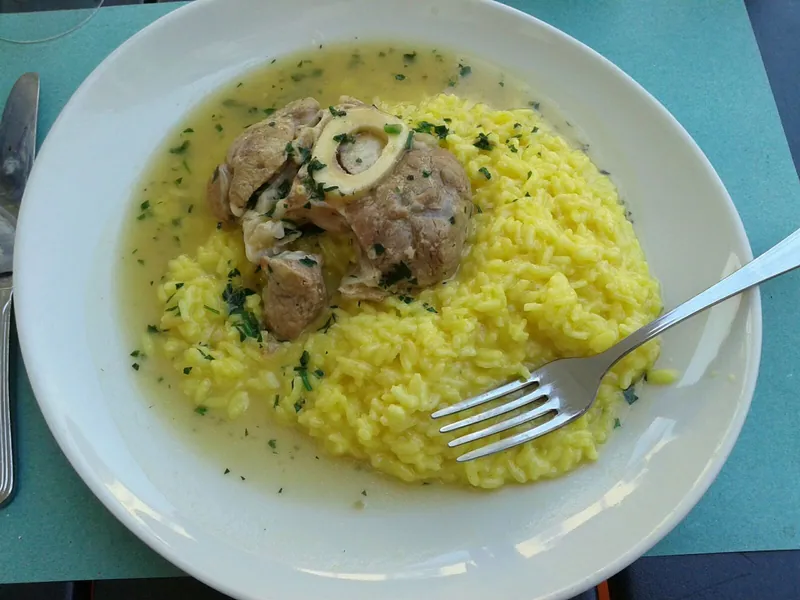
Braised veal osso buco with a visible marrow bone, saffron-yellow risotto and parsley gremolata on a white plate

Photo: pier / Wikimedia Commons · CC BY-SA 4.0

Weekend

Milanese Osso Buco with Saffron Risotto

Fork-tender white-wine-braised veal shanks, lemony gremolata and creamy saffron risotto arrive hot together with a practical two-pot service plan.

Prep30 min
Cook150 min
Total180 min
Cost9.75

Directions

  1. Heat the oven and season the shanks

    Set a rack in the lower third and heat the oven to 325°F. Pat the veal shanks very dry. Snip the tough outer membrane in three places without cutting into the meat, then tie each shank snugly so it holds its shape. Season all over with 1 1/4 teaspoons salt and 1/2 teaspoon pepper; dust with the flour and shake off every loose patch.

  2. Brown deeply without crowding

    Heat the olive oil and 1 tablespoon butter in a wide 6-quart Dutch oven over medium-high until shimmering. Brown the shanks in two batches, 4 to 5 minutes per broad side and about 1 minute around the edges. Transfer to a plate. Lower the heat to medium and pour off all but 2 tablespoons fat.

  3. Build the white-wine braise

    Add half the onion, the carrot and celery to the Dutch oven. Cook for 6 to 8 minutes, scraping the browned bits, until glossy and lightly golden. Mince 2 garlic cloves; stir them in for 30 seconds. Pour in 1 cup wine and simmer until reduced by roughly half, 4 to 6 minutes. Add 2 cups stock, sage, rosemary and bay leaf. Return the shanks in one layer with the marrow sides facing up; the liquid should reach halfway up the meat. Add a little stock if needed.

  4. Braise until spoon-tender

    Bring the liquid just to a simmer, cover and transfer to the 325°F oven. Braise for 1 hour, then turn the shanks carefully and spoon liquid over them. Cover and continue for 45 to 75 minutes, until a thin skewer slips into the thickest meat with almost no resistance and the meat is beginning to pull from the bone. Veal is safe at 145°F after a 3-minute rest, but shanks usually need about 195 to 205°F to become tender; tenderness, not the higher number alone, is the finish test.

  5. Steep the saffron stock

    When the shanks have about 35 minutes left, bring 2 1/2 cups stock and 1 cup water to a bare simmer in a saucepan, then keep warm over low heat. Crush the saffron between your fingers into a small heatproof cup, add 1/2 cup of the hot stock and steep for 10 minutes.

  6. Start the risotto

    Melt 2 tablespoons butter in a wide 3- to 4-quart saucepan over medium. Add the remaining onion and 1/4 teaspoon salt; cook for 4 to 5 minutes until translucent, not browned. Stir in the rice and cook for 2 minutes, until each grain is hot and the edges look translucent. Add the remaining 1/2 cup wine and stir until the pan is nearly dry.

  7. Cook the risotto to a flowing finish

    Add the hot saffron infusion and stir steadily until mostly absorbed. Add the remaining hot stock 1/2 cup at a time, stirring often and waiting until the pan is almost dry before the next addition. Begin tasting at 16 minutes; the rice should be creamy and flowing but retain a tiny firm center, usually after 18 to 22 minutes. Add hot water if the stock runs out before the rice is ready. Remove from the heat and beat in 1 tablespoon butter and the Parmigiano. Loosen with 2 to 4 tablespoons hot stock so it settles into a soft wave rather than a mound.

  8. Make the gremolata and finish the sauce

    Finely grate or mince the remaining 2 garlic cloves and toss with the parsley and lemon zest. Transfer the tender shanks to a warm plate and remove the twine. Discard the herb stems and bay leaf. Skim excess fat, then simmer the braising liquid on the stovetop for 5 to 10 minutes until it lightly coats a spoon. Whisk in the remaining 1 tablespoon butter and half the gremolata; season with the remaining pepper and salt as needed. Return the shanks just long enough to glaze them.

  9. Plate without losing the timing

    Spoon the loose saffron risotto onto four warmed plates. Set one shank on each portion, marrow side visible, and spoon over the glossy braising sauce. Finish with the remaining gremolata and extra Parmigiano. Serve immediately while the risotto still flows.

Why this works

Why it worksCutting the shank membrane and tying the meat prevents curling while the slow, covered 325°F braise converts collagen without boiling the meat dry.
Why it worksReducing the wine before adding stock concentrates acidity and dissolves the browned fond, giving a tomato-free braise depth without making the sauce heavy.
Why it worksSteeping crushed saffron in hot stock extracts its color and aroma evenly; adding that infusion first distributes it through every rice grain.
Why it worksFinishing gremolata in two stages puts some garlic, lemon and parsley into the sauce while preserving a fresh aromatic layer on the plate.
Why it worksStarting the risotto only when the shanks are nearly tender creates a built-in buffer: the braise can wait covered, but properly flowing risotto cannot.

Swaps & notes

Easy swaps

  • For a beef version, use four 1 1/2-inch cross-cut beef shanks of similar weight; expect the braise to need 30 to 60 minutes longer and judge by skewer tenderness.
  • For a gluten-free braise, replace the flour with an equal volume of fine rice flour; it browns cleanly and still gives the reduced sauce light body.
  • Carnaroli stays especially creamy and resilient, but Arborio is easier to find. Do not use long-grain rice; it will not release enough starch for this risotto.
  • If avoiding alcohol, replace each addition of wine with the same amount of stock plus 2 teaspoons fresh lemon juice for the braise and 1 teaspoon for the risotto.
  • Vegetable stock works for the risotto, but use veal or chicken stock in the braise so its sauce retains savory body.

Cook notes

  • Traditional context: Regione Lombardia describes ossobuco as cross-cut veal shank finished with gremolata and notes that it is served as a one-plate meal with yellow risotto. This version keeps that classic pairing and uses a tomato-free white-wine braise, a documented older style.
  • Food-safety checkpoint: USDA FSIS sets 145°F with a 3-minute rest as the minimum for whole veal cuts. Tough shanks need continued gentle cooking well past that minimum for collagen to soften; the skewer test remains the reliable texture check.
  • Two-pot service timeline: T-35 minutes, warm the stock and steep saffron; T-25, soften the risotto onion; T-20, toast the rice and add wine; T-18 through T-2, add stock gradually; T-10, reduce the braising sauce; T-3, finish the risotto with butter and cheese; T-0, plate both immediately.
  • Braise-readiness checklist: the meat should stay attached to the bone but yield to a thin skewer; the marrow should remain visible; the sauce should coat a spoon without tasting floury; and the surface should show only a quiet tremble, never a hard boil.
  • Rescue matrix — tough shank: add 1/2 cup hot stock and braise 20 minutes longer; thin sauce: keep the shanks warm and reduce uncovered; greasy sauce: skim before reduction; stiff risotto: beat in hot stock 1 tablespoon at a time; soupy risotto: stir over medium heat for 60 to 90 seconds before finishing.
  • The published photograph was visually checked against the final recipe: it shows a cross-cut braised veal shank with visible marrow, saffron-yellow risotto, pale braising juices and green herb garnish.

Storage

Refrigerate shanks and sauce together in a shallow airtight container and the risotto separately within 2 hours; use within 3 days. Reheat the covered shanks with a splash of stock in a 325°F oven until the center reaches 165°F, about 20 to 25 minutes. Warm risotto gently on the stovetop with 2 to 3 tablespoons stock per serving, stirring until 165°F; it will be softer than freshly made. Freeze shanks in their sauce for up to 2 months, but do not freeze the risotto because its texture turns grainy.

Questions

Why is my osso buco still tough after two hours?

The oven temperature, shank thickness and animal age all change the collagen timetable. If a skewer meets resistance, the meat is not overcooked; it is usually under-braised. Add enough hot stock to restore the liquid halfway up the shanks, cover and continue at 325°F in 20-minute intervals. Stop only when the skewer slides in easily and the meat still holds around the bone.

Can I make the veal shanks ahead and cook the risotto later?

Yes. Braise the shanks through the tender stage, cool them in their sauce and refrigerate for up to 2 days. Lift off the hardened fat, then reheat covered at 325°F until the center reaches 165°F. Reduce and finish the sauce while you cook the risotto fresh; this is the easiest approach for guests because only the rice needs last-minute attention.

How do I keep the risotto creamy while I plate four servings?

Warm the plates and finish the rice slightly looser than you think it should be; a spoon dragged through the pan should leave a trail that closes slowly. Keep 1/2 cup hot stock beside the stove. If the rice tightens while the sauce is finished, beat in stock 1 tablespoon at a time. Do not cover the risotto, which traps steam and pushes it past al dente.

Milanese Osso Buco with Saffron Risotto
Screen stays awake when supported.
1. Heat the oven and season the shanksSet a rack in the lower third and heat the oven to 325°F. Pat the veal shanks very dry. Snip the tough outer membrane in three places without cutting into the meat, then tie each shank snugly so it holds its shape. Season all over with 1 1/4 teaspoons salt and 1/2 teaspoon pepper; dust with the flour and shake off every loose patch.
2. Brown deeply without crowdingHeat the olive oil and 1 tablespoon butter in a wide 6-quart Dutch oven over medium-high until shimmering. Brown the shanks in two batches, 4 to 5 minutes per broad side and about 1 minute around the edges. Transfer to a plate. Lower the heat to medium and pour off all but 2 tablespoons fat.
3. Build the white-wine braiseAdd half the onion, the carrot and celery to the Dutch oven. Cook for 6 to 8 minutes, scraping the browned bits, until glossy and lightly golden. Mince 2 garlic cloves; stir them in for 30 seconds. Pour in 1 cup wine and simmer until reduced by roughly half, 4 to 6 minutes. Add 2 cups stock, sage, rosemary and bay leaf. Return the shanks in one layer with the marrow sides facing up; the liquid should reach halfway up the meat. Add a little stock if needed.
4. Braise until spoon-tenderBring the liquid just to a simmer, cover and transfer to the 325°F oven. Braise for 1 hour, then turn the shanks carefully and spoon liquid over them. Cover and continue for 45 to 75 minutes, until a thin skewer slips into the thickest meat with almost no resistance and the meat is beginning to pull from the bone. Veal is safe at 145°F after a 3-minute rest, but shanks usually need about 195 to 205°F to become tender; tenderness, not the higher number alone, is the finish test.
5. Steep the saffron stockWhen the shanks have about 35 minutes left, bring 2 1/2 cups stock and 1 cup water to a bare simmer in a saucepan, then keep warm over low heat. Crush the saffron between your fingers into a small heatproof cup, add 1/2 cup of the hot stock and steep for 10 minutes.
6. Start the risottoMelt 2 tablespoons butter in a wide 3- to 4-quart saucepan over medium. Add the remaining onion and 1/4 teaspoon salt; cook for 4 to 5 minutes until translucent, not browned. Stir in the rice and cook for 2 minutes, until each grain is hot and the edges look translucent. Add the remaining 1/2 cup wine and stir until the pan is nearly dry.
7. Cook the risotto to a flowing finishAdd the hot saffron infusion and stir steadily until mostly absorbed. Add the remaining hot stock 1/2 cup at a time, stirring often and waiting until the pan is almost dry before the next addition. Begin tasting at 16 minutes; the rice should be creamy and flowing but retain a tiny firm center, usually after 18 to 22 minutes. Add hot water if the stock runs out before the rice is ready. Remove from the heat and beat in 1 tablespoon butter and the Parmigiano. Loosen with 2 to 4 tablespoons hot stock so it settles into a soft wave rather than a mound.
8. Make the gremolata and finish the sauceFinely grate or mince the remaining 2 garlic cloves and toss with the parsley and lemon zest. Transfer the tender shanks to a warm plate and remove the twine. Discard the herb stems and bay leaf. Skim excess fat, then simmer the braising liquid on the stovetop for 5 to 10 minutes until it lightly coats a spoon. Whisk in the remaining 1 tablespoon butter and half the gremolata; season with the remaining pepper and salt as needed. Return the shanks just long enough to glaze them.
9. Plate without losing the timingSpoon the loose saffron risotto onto four warmed plates. Set one shank on each portion, marrow side visible, and spoon over the glossy braising sauce. Finish with the remaining gremolata and extra Parmigiano. Serve immediately while the risotto still flows.