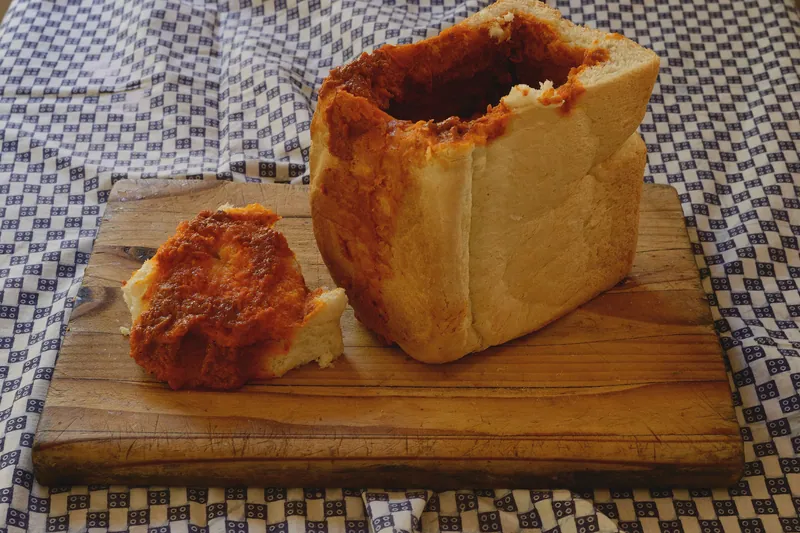
Durban-style chicken curry filling a hollowed rectangular white bread loaf with the curry-soaked bread cap resting beside it on a wooden board

Photo: Lucinda Jolly / Wikimedia Commons · CC BY-SA 4.0

Weekend

Durban-Style Chicken Curry Bunny Chow with Potatoes

Tender chicken and gravy-soaked potatoes simmer in a warmly spiced Durban-style curry, then spill into hollowed white loaves whose soft bread caps become the perfect edible spoon.

Prep30 min
Cook55 min
Total90 min
Cost$4.20

Directions

  1. Season the chicken and mix the quick sambal

    Pat the chicken dry, then toss it with 3/4 teaspoon salt and the black pepper. In a separate bowl, toss the cabbage and carrot with the vinegar, sugar and 1/4 teaspoon salt. Massage for 30 seconds, cover and refrigerate while the curry cooks. Keep the raw-chicken bowl and utensils away from the ready-to-eat sambal.

  2. Brown the chicken in uncrowded batches

    Heat 2 tablespoons oil in a wide 5- to 6-quart heavy pot over medium-high until shimmering. Add half the chicken in one layer and cook for 3 to 4 minutes, turning once, until browned but not cooked through. Transfer to a clean plate and repeat with the remaining chicken. Browning in two batches preserves the fond that will deepen the gravy instead of steaming the meat.

  3. Build the onion and spice base

    Lower the heat to medium and add the remaining tablespoon oil and the onion. Cook for 8 to 10 minutes, stirring and scraping the browned bits, until soft and golden at the edges. Add the ginger and garlic and cook for 1 minute. Stir in the curry powder, coriander, cumin, turmeric, cayenne, fennel and cinnamon for 30 seconds, just until fragrant; do not let the spices scorch. Add the tomato paste and cook for 2 minutes, stirring, until it darkens slightly.

  4. Simmer the glossy chicken-and-potato curry

    Stir in the crushed tomatoes, stock, potatoes, curry leaves and remaining 1/2 teaspoon salt. Return the chicken and any juices to the pot. Bring to a steady simmer, then reduce the heat to medium-low and partially cover. Cook for 25 to 30 minutes, stirring twice, until the potatoes are easily pierced, the gravy coats a spoon and every chicken piece reaches at least 165°F (74°C) in the center on an instant-read thermometer. Add stock 2 tablespoons at a time only if the gravy threatens to catch before the potatoes are tender.

  5. Finish and rest the curry

    Remove the lid and simmer for 3 to 5 minutes if the gravy is loose; bunny chow needs a spoonable curry that moistens the bread without immediately running through it. Remove from the heat, discard the curry leaves if desired, and stir in the lemon juice and cilantro. Taste and adjust salt or cayenne. Rest for 5 minutes so the gravy thickens slightly while you cut the loaves.

  6. Cut four sturdy bread vessels

    Cut each unsliced loaf crosswise into two equal blocks. Stand each block cut-side up. With a small serrated knife, score a rectangle 3/4 inch from the crust without cutting through the bottom, then pull out the soft center in one large piece. Leave a 3/4-inch wall and base so the curry stays contained. Keep each soft bread plug intact as its cap; do not toast the bread, because the soft crumb is meant to absorb the gravy.

  7. Fill to the brim and serve immediately

    Set each hollowed loaf on a shallow plate or board. Spoon in curry in stages, pushing chicken and potatoes into the corners and finishing with enough gravy to soak the inner crumb. Lean the bread cap against the loaf as shown in the verified photograph. Serve at once with the drained cabbage-carrot sambal and extra cilantro alongside. Eat by tearing pieces from the cap and walls, keeping the gravy inside the crust.

Why this works

Why it worksChicken thighs stay juicy during the two-stage brown-and-simmer method, while their fond gives the tomato gravy a deeper savory base.
Why it worksCooking the spices briefly in oil releases fat-soluble aromas; frying the tomato paste afterward removes its raw edge before liquid enters the pot.
Why it worksYukon Gold potatoes hold their shape but release enough starch to thicken the curry naturally, creating the gravy-soaking consistency associated with Durban curry.
Why it worksA 3/4-inch bread wall is thick enough to contain the filling yet leaves plenty of soft crumb to absorb sauce; an unsliced sandwich loaf gives control that pre-sliced bread cannot.
Why it worksResting the finished curry for five minutes lets starch and gelatin tighten the gravy so it saturates the loaf gradually rather than leaking through the base.

Swaps & notes

Easy swaps

  • For a vegetarian bunny chow, replace the chicken with two drained 15-ounce cans of chickpeas and add them after the potatoes have simmered for 15 minutes. Use vegetable stock; cook until the potatoes are tender and the gravy is thick.
  • Boneless chicken breast can replace thighs, but cut it into 2-inch pieces and add it for only the final 12 to 15 minutes of simmering. Still verify 165°F (74°C) in the thickest pieces.
  • Russet potatoes can replace Yukon Golds. Cut them slightly larger and stir gently because their higher starch content makes them break down and thicken the sauce faster.
  • If fresh curry leaves are unavailable, omit them rather than substituting dried bay leaves, which have a different flavor. The toasted ground spices, ginger and garlic still form a complete curry base.
  • A sturdy unsliced pullman loaf is ideal, but any fresh rectangular white loaf with a tight crumb works. Avoid an airy artisan boule: large holes and a hard irregular crust make it difficult to hold the curry.

Cook notes

  • South African Tourism describes bunny chow as a Durban specialty made by hollowing a quarter or half white loaf and filling it with curry; its overview also identifies soft-cooking potatoes and a well-cooked onion-and-garlic base as hallmarks of Durban curry. This home recipe follows those defining features without claiming one disputed origin story as settled fact.
  • The National Department of Health's safer-food guidance recommends thorough cooking and notes that 70°C helps ensure food safety. This recipe uses the more conservative 165°F (74°C) endpoint for chicken and reheated leftovers and requires a thermometer rather than judging by color.
  • The CC BY-SA 4.0 photograph was inspected at full size before publication. It clearly shows curry inside a tall, hollowed rectangular white loaf with the curry-soaked bread cap beside it; the recipe's bread shape, filling consistency, assembly and alt text are limited to those visible details.
  • Use a pot at least 5 quarts wide enough to brown chicken in two batches. A small crowded saucepan traps steam, leaves the meat pale and slows the potato simmer.
  • The 90-minute total includes a five-minute rest. Cut the bread only after the curry is ready so its soft interior does not dry out before filling.
  • This recipe contains wheat. Check curry powder and stock labels if cooking for someone with additional allergies, and prevent raw-chicken juices from contacting the sambal, bread or serving board.
  • Calories and cost are estimates for one filled half-loaf block with one-quarter of the chicken curry and sambal. Loaf size, the amount of removed crumb and local chicken prices will change both.

Storage

Store curry, sambal and uncut bread separately. Refrigerate the cooled curry in a shallow airtight container within 2 hours for up to 3 days; keep the sambal refrigerated for up to 2 days and the bread sealed at room temperature for 1 day or freeze it. Reheat only the curry in a covered saucepan over medium-low with a splash of stock, stirring until it reaches 165°F (74°C) throughout. Do not refrigerate or reheat an assembled bunny chow: the bread becomes fragile and soggy. Freeze the curry without bread or sambal for up to 2 months, thaw overnight in the refrigerator, then reheat to 165°F before filling freshly cut loaves.

Questions

Why did my bunny chow leak through the bottom?

The bread base was cut too thin, the curry was too watery or it sat assembled too long. Leave at least 3/4 inch of crumb on the base, reduce the uncovered curry until it coats a spoon, rest it for five minutes and fill immediately before serving. Set the loaf on a shallow plate so even a very juicy curry remains easy to eat.

Can I make the chicken curry ahead without ruining the bread?

Yes. Cook and chill the curry up to three days ahead, but leave every loaf whole. Reheat the curry to 165°F (74°C), adding only enough stock to loosen it to a spoon-coating gravy. Hollow and fill fresh bread at the table; never store the assembled loaf.

How spicy should Durban-style bunny chow be?

It should taste warmly spiced with a noticeable chile lift, but there is no single required heat level. Begin with mild curry powder and 1/4 teaspoon cayenne for a gentler version, or use medium curry powder and the full 1/2 teaspoon. Bloom the spices as written; adding raw curry powder at the end creates harshness rather than rounded heat.

Durban-Style Chicken Curry Bunny Chow with Potatoes
Screen stays awake when supported.
1. Season the chicken and mix the quick sambalPat the chicken dry, then toss it with 3/4 teaspoon salt and the black pepper. In a separate bowl, toss the cabbage and carrot with the vinegar, sugar and 1/4 teaspoon salt. Massage for 30 seconds, cover and refrigerate while the curry cooks. Keep the raw-chicken bowl and utensils away from the ready-to-eat sambal.
2. Brown the chicken in uncrowded batchesHeat 2 tablespoons oil in a wide 5- to 6-quart heavy pot over medium-high until shimmering. Add half the chicken in one layer and cook for 3 to 4 minutes, turning once, until browned but not cooked through. Transfer to a clean plate and repeat with the remaining chicken. Browning in two batches preserves the fond that will deepen the gravy instead of steaming the meat.
3. Build the onion and spice baseLower the heat to medium and add the remaining tablespoon oil and the onion. Cook for 8 to 10 minutes, stirring and scraping the browned bits, until soft and golden at the edges. Add the ginger and garlic and cook for 1 minute. Stir in the curry powder, coriander, cumin, turmeric, cayenne, fennel and cinnamon for 30 seconds, just until fragrant; do not let the spices scorch. Add the tomato paste and cook for 2 minutes, stirring, until it darkens slightly.
4. Simmer the glossy chicken-and-potato curryStir in the crushed tomatoes, stock, potatoes, curry leaves and remaining 1/2 teaspoon salt. Return the chicken and any juices to the pot. Bring to a steady simmer, then reduce the heat to medium-low and partially cover. Cook for 25 to 30 minutes, stirring twice, until the potatoes are easily pierced, the gravy coats a spoon and every chicken piece reaches at least 165°F (74°C) in the center on an instant-read thermometer. Add stock 2 tablespoons at a time only if the gravy threatens to catch before the potatoes are tender.
5. Finish and rest the curryRemove the lid and simmer for 3 to 5 minutes if the gravy is loose; bunny chow needs a spoonable curry that moistens the bread without immediately running through it. Remove from the heat, discard the curry leaves if desired, and stir in the lemon juice and cilantro. Taste and adjust salt or cayenne. Rest for 5 minutes so the gravy thickens slightly while you cut the loaves.
6. Cut four sturdy bread vesselsCut each unsliced loaf crosswise into two equal blocks. Stand each block cut-side up. With a small serrated knife, score a rectangle 3/4 inch from the crust without cutting through the bottom, then pull out the soft center in one large piece. Leave a 3/4-inch wall and base so the curry stays contained. Keep each soft bread plug intact as its cap; do not toast the bread, because the soft crumb is meant to absorb the gravy.
7. Fill to the brim and serve immediatelySet each hollowed loaf on a shallow plate or board. Spoon in curry in stages, pushing chicken and potatoes into the corners and finishing with enough gravy to soak the inner crumb. Lean the bread cap against the loaf as shown in the verified photograph. Serve at once with the drained cabbage-carrot sambal and extra cilantro alongside. Eat by tearing pieces from the cap and walls, keeping the gravy inside the crust.